How I'm using Claude to plan and run this build
 Mike Hirsch · · 5 min read
A dedicated AI project, primary sources over forum lore, one home for every kind of information, and an honest list of what it caught and what it got wrong.
I bought a 4Runner with no off-road experience. My day job is turning a whiteboard into something a team can actually build. So I did the only thing I know how to do with a problem I don’t understand: I made it a project, and I gave it an advisor.
The advisor is Claude. It’s been very useful, and occasionally wrong. Both are below.
The setup
Everything lives in a single Claude Project called “4Runner Build.” A Project is a workspace with its own standing instructions and documents, so every conversation starts with the full context instead of me re-explaining the truck.
The instructions are short:
- Act as an advisor and instructor on the 5th gen 4Runner, overlanding and off-roading.
- Always check the existing context, and ask when unsure.
- Always plan first, show me the plan, then execute.
That last rule does the most work. Nothing gets bought, rewritten or reorganized until I’ve seen the plan.
Primary sources over forum lore
The internet has endless opinions on 4Runner builds, most of them written for someone else’s truck, trails and budget. So the project is anchored to primary sources, ranked:
- The two documents from my class at 5280 Offroad: the orientation deck and their Extended Off-Road Adventure Preparation checklist. These outrank anything from a forum.
- My own data: a Harbor Freight toolkit spreadsheet I built, with prices checked against live product pages.
- Vehicle-specific sources for the rest: torque specs, KDSS compatibility, known failure points on this generation.
A forum post can still make the list. It just has to lose an argument with a checklist first.
One home for each kind of information
What made this work was deciding where each kind of information lives, so nothing drifts out of sync:
- The Build Plan holds the phase order and scope. It deliberately has no prices or item lists.
- A decisions doc holds the reasoning: why the list looks the way it does, what got reversed, and the buying rules.
- Research docs hold open questions, like the head unit and camera research, until they’re resolved.
- A live tracker holds everything that changes: every item, its store options, what’s in my basket, every order, and all the totals.
If a number changes, it changes in one place. If I want to know why something is on the list, there’s one place to look. I’ve spent twelve years telling customers to do exactly this. It’s humbling to finally take the advice.
The tracker, and true landed cost
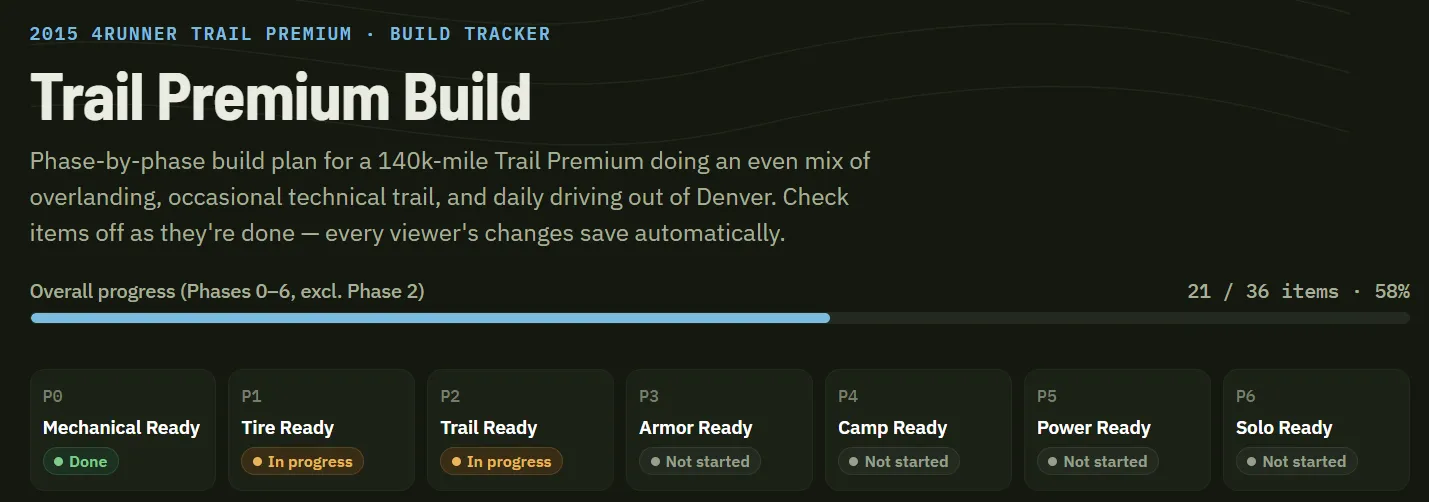
The tracker is a small web app Claude built and keeps updated: a phase rail, a parking lot for things deliberately out of order, and a Phase 2 shopping list you can filter by store. It will even sort a Harbor Freight run by aisle, which is either very useful or a sign of a problem.
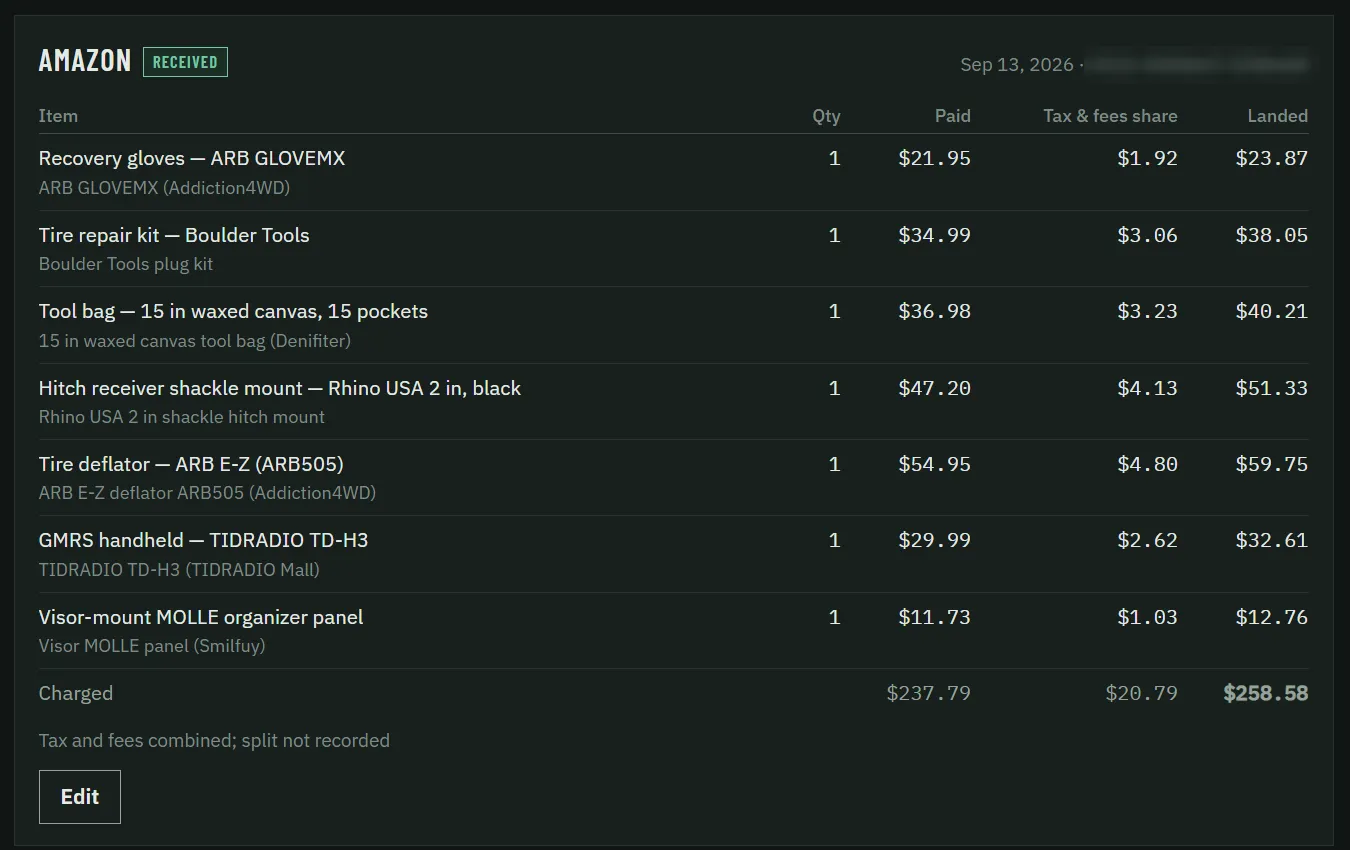
The feature I like most is landed cost. The order total is the source of truth, and tax and shipping get spread across each line in proportion to its price. My first gear order was $237.79 of items and $258.58 charged, so the $47.20 hitch mount actually cost me $51.33.
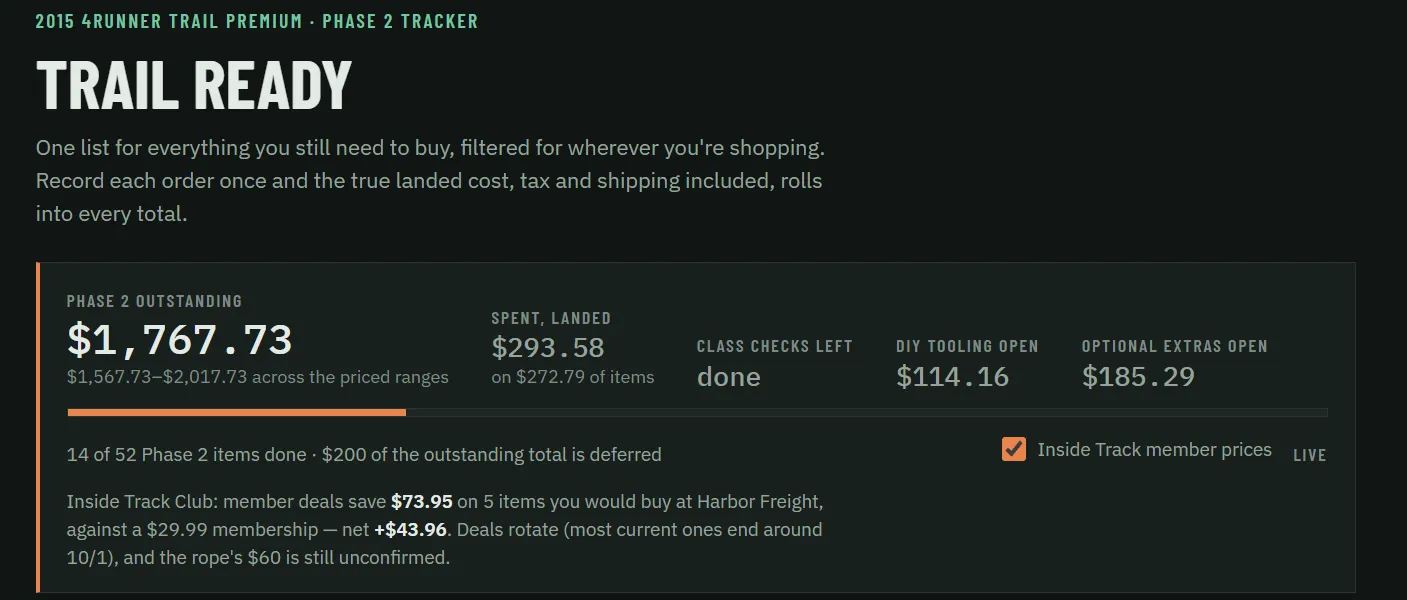
As of this writing, Phase 2 sits at 14 of 52 items done, $293.58 spent landed, and $1,767.73 still open.
The membership math
It does small decision math too, and this is my favorite example.
Harbor Freight’s Inside Track membership costs $29.99 a year. Before one specific recovery rope went on the list, my member savings came to about $16, so the answer was don’t join. Then the rope showed up: $119.99 retail, $60 for members. The answer flipped.
Today it reads $73.95 in member savings across five items, net $43.96 after the fee, recalculated live from whatever is still open on the list. One asterisk the tracker is honest about: the rope’s member price is unconfirmed, and it’s in-store only. The whole verdict currently rides on one shelf tag in Aurora.
What it caught
- Brakes. My first Phase 0 plan covered fluids, the KDSS system and the cooling system, and never mentioned brakes. Checking the plan against 5280’s prep checklist surfaced it: brake fluid change, pads to a 25% minimum, brake lines. In Colorado, with long mountain descents, that was the gap that mattered most.
- Two standards, not one. The class prep checklist read like a list of class prerequisites. It wasn’t. It’s the standard for multi-day trips. Splitting “Class Ready” from “Trip Ready” kept me from buying about $2,000 of gear for a $150 orientation day.
- A torque wrench. It wasn’t on any list until the toolkit reconciliation. The prep checklist says to re-torque lug nuts to spec, and a breaker bar can’t do that.
Where it got corrected
- Over-weighting the optional gear. Early research leaned hard on traction boards, kinetic ropes and shovels, the photogenic stuff. 5280 files those under optional. Their required list is tire repair, a pressure gauge, a jack, first aid, comms and spares. The spares-and-fluids half of my list didn’t exist until their checklist came in.
- The rope reversal. The original spec argued against an oversized kinetic rope and picked a correctly sized 3/4” ASR Offroad at $121. Then I found a 1” Badland Apex at a $60 member price, and 5280 runs mixed groups where the pulling truck may be full-size. The physics in the original argument still holds. The context changed. That’s its own post.
- Small stuff. A product page fetched while logged out showed a different price than the member price I saw. Two listings shared one item number in different sizes. Both got flagged “confirm at checkout” instead of taken as fact.
Where I still decide
Claude does the research, the math and the bookkeeping. It doesn’t make the calls.
- I see the full priced list and triage it myself, rather than getting a pre-cut “you only need these five things.”
- Questions go to the people who actually know. Whether the intro class expected a radio was an email to 5280. Whether a head unit takes a second camera input is an email to the manufacturer. The plan marks those open until a human answers.
- Taste is mine. Black gear instead of high-visibility orange, recovery boards stored inside instead of mounted, and the truck’s name.
Claude picked none of the gear. It did talk me out of about $2,000 of it.